 Blue Brazelton
The Living Record
Six weeks of research, scoping and review documents before and during the code. The most complete build, and the most process.
- Tools
- ChatGPT (Astra model) for design and research; Codex for the code
- When
- About six weeks, ending October 13, 2026
- How
- Long, document-driven collaboration: written scope, research and design phases first, then code
- What you can play
- Four complete career paths (social scientist, historian, environmental scientist, legal scholar), 12 chapters each, 13 endings
- Project size
- More than 21,000 files, including 145 planning and review documents at the top level
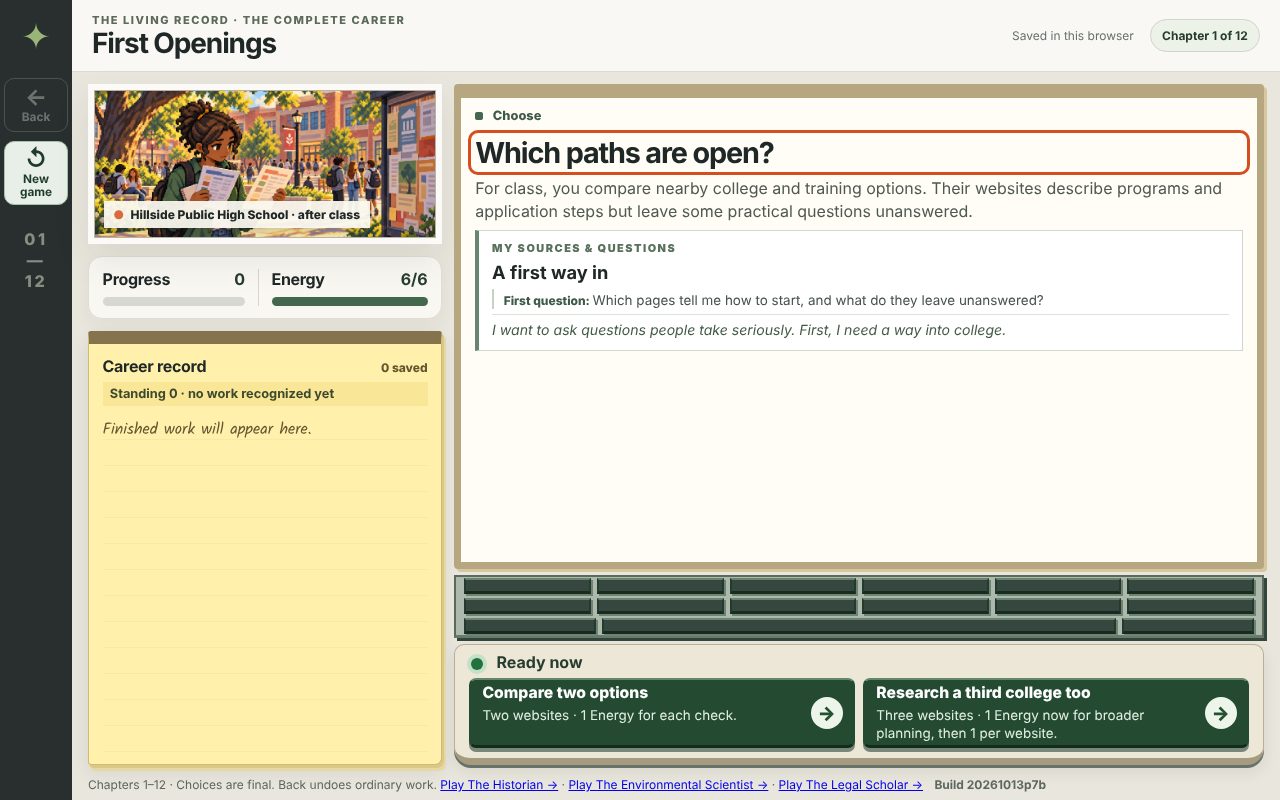
Each career saves separately in your browser. For the web, the scene illustrations were converted from PNG to smaller WebP images; nothing else in the game was changed.
How it was builtBuild 1 was the long road. I worked in ChatGPT with the Astra model for design and research, and in Codex for the code, across many sessions over about six weeks, and the first three of those weeks produced no game at all. They produced documents: a definition of what “the top of academia” means, a twelve-chapter career arc grounded in research on student success, an economy model, a decision log, and a risk register, with every session ending in a handoff note for the next one (and, eventually, records of the records). The economy is where I would do things differently. We spent a lot of time talking about the game economy (how much each task should cost and how quickly the scholar’s Energy should come back) when we should have taken a step back and looked for more resources and advice, because balancing an incremental game is a solved problem and plenty of designers have already written down how to do it. The first playable code arrived on September 30, the first full build was accepted on October 12, and near the end, when I could not face another playtest, I had Claude play one full career and write an audit, and then had Codex check Claude’s audit.
The scope documentThe scope document approved on September 11, 2026, at the start of Build 1, published as written. It describes one social-science campaign and lists separate legal and other campaigns as outside the base game. Read the scope document.
What workedThis is the most complete game of the three by a wide margin (four careers, 48 chapters, 13 endings, and saves that hold up), but my favorite part is smaller than any of that. Every illustrated scene has a tired version that appears when your scholar runs low on Energy, and anyone who has been through grad school will recognize that scholar immediately. Tying Energy in as a currency, something you spend on every task and run out of whether or not the work is finished (the game’s own rule is that work still counts at zero; it just loses polish), is the most honest mechanic in any of the three builds. The career content also took the research seriously, so setbacks become new routes instead of dead ends, which is closer to how academic careers actually work than anything the other two builds attempted.
Where the slop crept inThe slop in Build 1 is invisible to a player, because it lives in the folder. The approved scope promised one social-science career and said the base game “does not contain four fully separate versions of the preceding career,” and it shipped four anyway, with nobody, including me, stepping in to stop it. The process generated about 555,000 words of planning and review, written in a style I eventually stopped reading; when I playtested, I wrote that “whenever the writing got really technical/in the weeds about the details, i stopped paying attention.” The build was checked with 34,690 automated save tests, while the same records concede that “unfamiliar-player comprehension” remained unmeasured. Work can be thorough and accurate and still be slop if nobody can stand to read it.
The other builds: Build 2: The Patience Game · Build 3: Citation Needed